
Friends of Padre Beach Report 8/05/2015
By Tyler Thorsen

Via Capt Billy Sandifer Wind was forecast to blow 10-15 knots and blew to 29 mph. The day before it blew to 27 mph. By noon the wind had increased the current to the point effective lure fishing was impossible. Whiting were available but other than that catching was non-existent. The water was quite murky North of the Big Shell in the morning. Some small tar balls were observed on the north end of the beach to near the 25 mile mark. Believe it or not some amount of tar ball activity is typical during the hottest part of the summer. 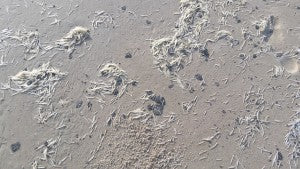
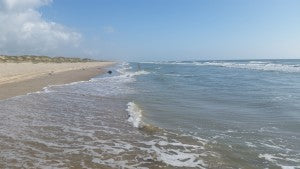
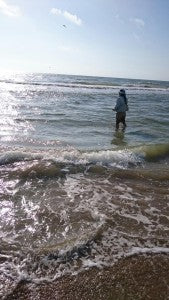 The water began to show a little color as we traveled South and the last 10 miles North of the Port Mansfield jetties was the clearest water on the beach.
 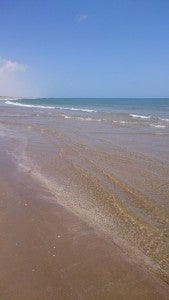 Water temperature was in the 80’s the entire length of the beachfront. Scattered bait was observed with the largest concentrations of mullet being observed in the 30’s. Little bait was seen the farther South we went. Several mixed flocks of fish eating birds were observed South of the 30 mile feeding offshore and some shoals of Dusky Anchovies were seen although there was no fish activity observed feeding on them. Here is a video taken at the 41.5 mile area. The beach was a highway from the end of the pavement to the 18 mile and then soft spots were encountered frequently. They increased in number as we continued to the South and upon several occasions going into 4 wheel high was required. The Turtle Patrol moved out of the Turtle Shack and secured the building for the season. In late afternoon the water had cleared quite a bit the entire length of the beach. Birds observed included 2 White-tailed Hawks, 1 Osprey, 1 Caracara, 13 Dark Ibis, 3 Spotted Sandpipers and scattered Ruddy Turnstones and Sanderling. Thousands of Black Terns were observed as were lesser numbers of Caspian Terns, Royal Terns, Sandwich Terns, Forester’s Terns, Least Terns, 4 Black Skimmers and numerous Laughing Gulls including juveniles. A shot of the windy surf just off the pavement as we prepared to leave.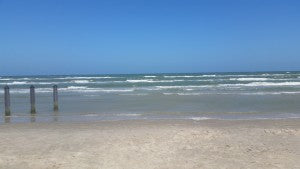
 Have fun. Billy
The water began to show a little color as we traveled South and the last 10 miles North of the Port Mansfield jetties was the clearest water on the beach. Water temperature was in the 80’s the entire length of the beachfront. Scattered bait was observed with the largest concentrations of mullet being observed in the 30’s. Little bait was seen the farther South we went. Several mixed flocks of fish eating birds were observed South of the 30 mile feeding offshore and some shoals of Dusky Anchovies were seen although there was no fish activity observed feeding on them. Here is a video taken at the 41.5 mile area. The beach was a highway from the end of the pavement to the 18 mile and then soft spots were encountered frequently. They increased in number as we continued to the South and upon several occasions going into 4 wheel high was required. The Turtle Patrol moved out of the Turtle Shack and secured the building for the season. In late afternoon the water had cleared quite a bit the entire length of the beach. Birds observed included 2 White-tailed Hawks, 1 Osprey, 1 Caracara, 13 Dark Ibis, 3 Spotted Sandpipers and scattered Ruddy Turnstones and Sanderling. Thousands of Black Terns were observed as were lesser numbers of Caspian Terns, Royal Terns, Sandwich Terns, Forester’s Terns, Least Terns, 4 Black Skimmers and numerous Laughing Gulls including juveniles. A shot of the windy surf just off the pavement as we prepared to leave. Have fun. Billy
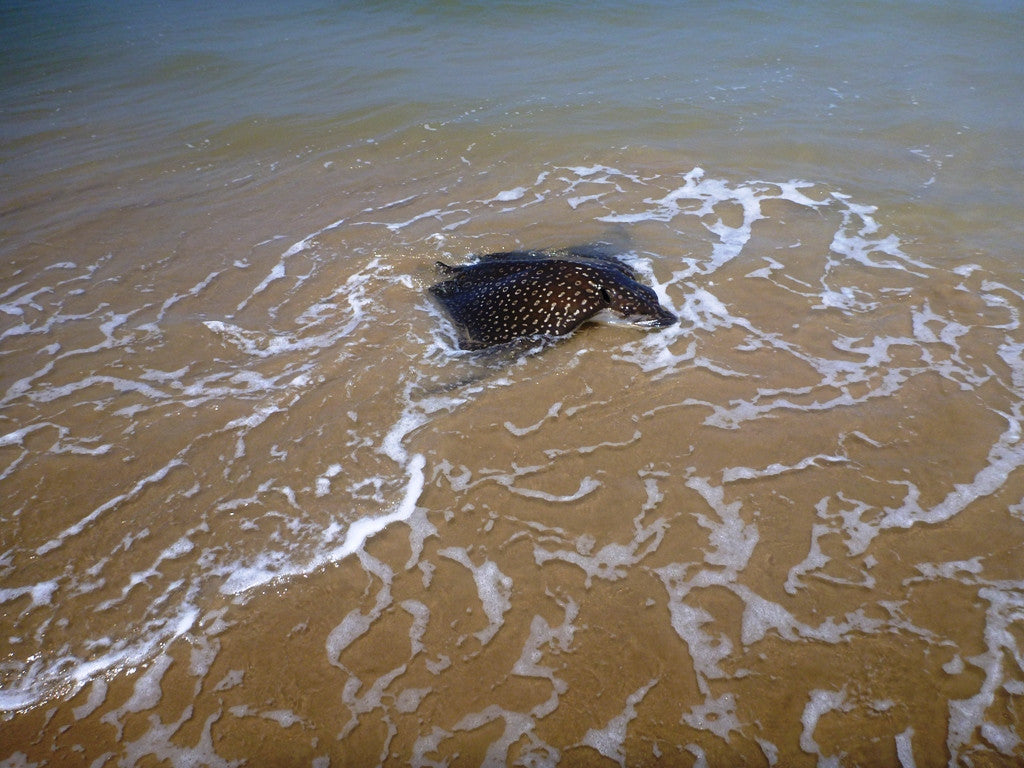
 Bait fish were observed throughout the 30’s and upper 40’s beach but no bait was observed inshore in the warmer, clear water south of there. Shoals of Dusky Anchovies were observed in the 2nd and 3rd. guts from the 35 mile south but none within casting range. One shoal had a school of skipjacks feeding on them. Flocks of mixed fish eating birds were observed offshore in various locations from the 35 mi. south. My friends were bait fishing and small Southern Whiting were caught from the 35 mi. to the 45 mile. Typically we catch Gulf Kingfish (Whiting) but these were Southern Whiting. They have small teeth, a yellowish trailing edge to their fins, and their bodies are rounder than Gulf Whiting. One Speckled Trout was caught in the 40’s on dead shrimp. We came upon a stranded Spotted Eagle Ray around the 48 mi. and with the help of Nick Meyer of Breakaway Tackle returned it to the sea. Nick said that earlier he and Brenda had came upon an even larger one stranded and returned it to the sea.
  One the way back North the water had turned varying shades of green from one end to the other although the water remained colder North of the 45 mi. An active upwelling of cold water was observed late in the day at the 31 mi. Driving North of the Big Shell was perfect and sadly I observed visitors leaving the beach at speeds of at least 70 mph. For some reason the Turtle Patrol is still on the beach altho they usually end their efforts around 15 July. There are many ledges forming at the water’s edge South of the 30 mi. That is typical at this time of year. On higher tides this forces drivers to go high on the beach into the loose sand and care needs to be taken at these locations. Biggest problem I saw with beach driving is an old one we have addressed countless times. People will not stay in the established track and drive across a wide expanse of beach making it tough on everyone and tearing the beach up badly. Have a good time; be careful, courteous and thoughtful of each other. The Black Terns are increasing in numbers as they return from their breeding grounds and this year’s crop of Laughing Gulls are on the beach. Good numbers of Brown Pelicans were observed. Other birds included Forester’s Terns, Sandwich Terns, Least Terns, Black Skimmers, Caspian Terns, and scattered Sanderlings, Willets, Long-billed Curlews and Wilson’s Plover. The overall number of birds on the beach will increase from now till Winter and will peak in late Sept. Billy


 The beach is spectacular with the light winds and high pressure.[/caption]
The trout are extremely difficult to get to hit an artificial lure so it was a slow grind althoough several big trout were seen that had no interest.
[caption width="1023" align="alignnone"]
The beach is spectacular with the light winds and high pressure.[/caption]
The trout are extremely difficult to get to hit an artificial lure so it was a slow grind althoough several big trout were seen that had no interest.
[caption width="1023" align="alignnone"] Billy with a 20" speckled trout.[/caption]
A fresh dead large Blacktip was laying on the bank in the Little Shell and a 6 foot Scalloped Hammerhead was laying dead at the 50 mile mark. These are game fish in Texas and it is against the law to kill them and leave them laying. They must be filleted or returned to the Sea. Special care must be taken to keep the Hammerhead alive. Don’t take them all the way out of the water and get your pics and the hooks out as quickly as possible or they will die.
[caption width="1024" align="alignnone"]
Billy with a 20" speckled trout.[/caption]
A fresh dead large Blacktip was laying on the bank in the Little Shell and a 6 foot Scalloped Hammerhead was laying dead at the 50 mile mark. These are game fish in Texas and it is against the law to kill them and leave them laying. They must be filleted or returned to the Sea. Special care must be taken to keep the Hammerhead alive. Don’t take them all the way out of the water and get your pics and the hooks out as quickly as possible or they will die.
[caption width="1024" align="alignnone"] Scalloped Hammerhead at the 50 mile mark.[/caption]
One Ridley Turtle was found nesting. Small Green Turtles have been abundant South of the Big Shell but only one was seen today. Birds are in very low numbers which is typical for mid June. A few of the regulars were seen along with Royal, Least, Sandwich, Forster’s, and Black Terns were present in low numbers. 3 sub adult Herring Gulls were observed. The large number of Black Terns seen last week have gone and continued their migration North. One Spotted Sandpiper was observed.
Soft spots are present from the Big Shell South as the sand dries and it is especially soft from the 50 mile beach to the jetties. There is a extremely soft place at the 54 mile that will test your 4 wheel drive and your driving skills. Forecast rain through next Wed. may help by packing the loose sand. Slow down when passing camps and watch for nesting turtles. Have fun and be safe.
Scalloped Hammerhead at the 50 mile mark.[/caption]
One Ridley Turtle was found nesting. Small Green Turtles have been abundant South of the Big Shell but only one was seen today. Birds are in very low numbers which is typical for mid June. A few of the regulars were seen along with Royal, Least, Sandwich, Forster’s, and Black Terns were present in low numbers. 3 sub adult Herring Gulls were observed. The large number of Black Terns seen last week have gone and continued their migration North. One Spotted Sandpiper was observed.
Soft spots are present from the Big Shell South as the sand dries and it is especially soft from the 50 mile beach to the jetties. There is a extremely soft place at the 54 mile that will test your 4 wheel drive and your driving skills. Forecast rain through next Wed. may help by packing the loose sand. Slow down when passing camps and watch for nesting turtles. Have fun and be safe.

